
Authoritarian Hijinx
“It’s an emergency if the president says it is.”

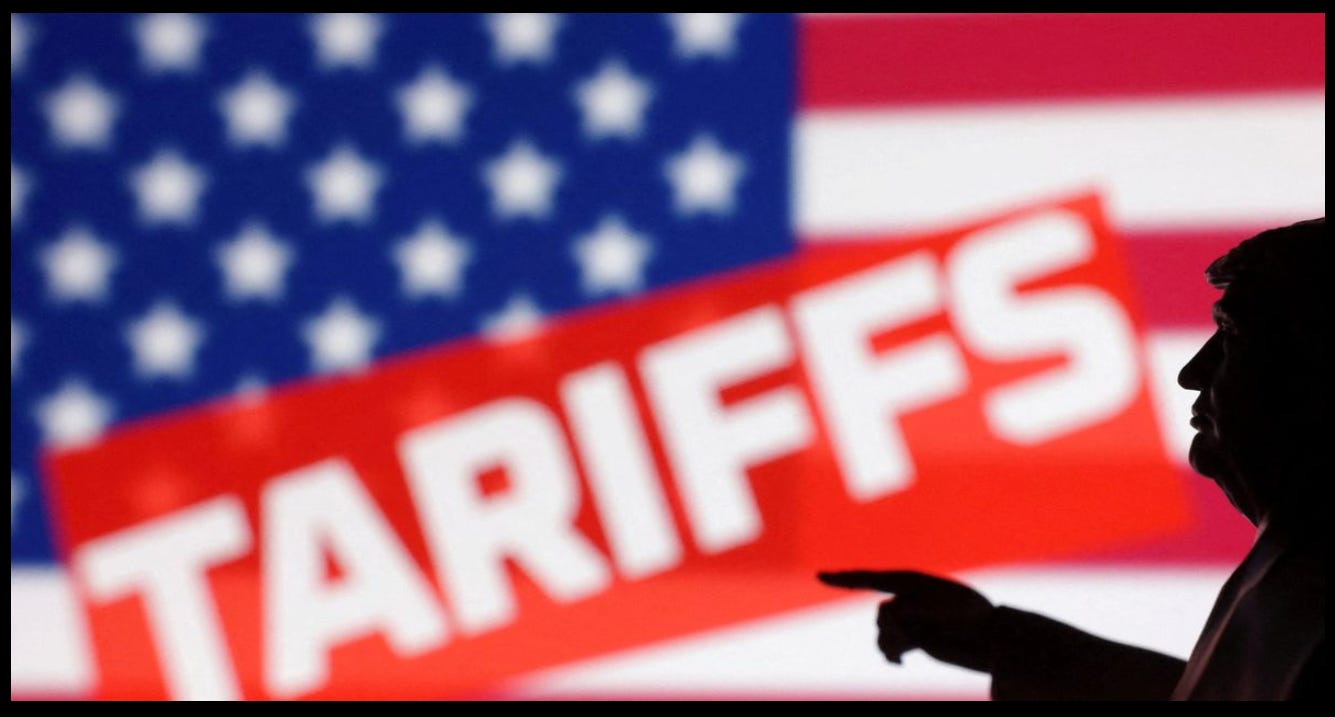
Sorry for my prolonged absence from this space, which I attribute to a prolonged bout of malaise, which I attribute to you know who. The recent No Kings rallies and Democratic near-sweep in the off-year elections have lifted my spirits, somewhat, so I’m trying to finish this column I started before I went dark. It’s about the use and misuse of presidential emergency declarations, which are back in the news because the U.S. Supine Court (not a typo) is deciding whether President Donald Trump abused his authority when he declared an emergency to impose tariffs on nearly every other nation on Earth. If you like my columns and wish to be emailed when a new one is posted (so you won’t have to go to the website to read them), please subscribe. It’s free. For now.
When presidents want to exceed their authority, legally, they can declare a national emergency. Chief executives have been doing that since 1794, when George Washington didn’t ask permission before federalizing state militias to put down a rebellion by frontier moonshiners who didn’t want to pay taxes on their whiskey. Other presidents have assumed emergency powers during the Civil War, Great Depression, World Wars I and II, 9/11, Hurricane Katrina and the Covid-19 pandemic.
The reason President Washington needed to declare an emergency is because the U.S. Constitution says the power to “call forth the Militia to execute the Laws of the Union, suppress Insurrections and repel Invasions” belongs to Congress alone. The reason for this is the framers of the Constitution didn’t want presidents with authoritarian tendencies to have unchecked military power.
The Constitution says nothing about making exceptions for national emergencies, but lawmakers soon realized the legislative branch wasn’t set up to deal with things like insurrections or invasions, so they passed the Militia Act of 1792, which gave the president the authority to respond to an emergency without congressional approval.
An emergency declaration “allows presidents to temporarily enhance their executive powers, with the idea being that passing laws through Congress is too slow in rare moments of crisis and the president needs the flexibility to act quickly,” NPR reporter Kat Lonsdorf noted in a June 9 story headlined, “What Trump’s national emergencies could mean for American democracy.”
A president can declare an emergency at any time, without approval from Congress, and what constitutes a national emergency has yet to be defined by law or legal precedent. “Essentially,” Lonsdorf opined, “it’s an emergency if the president says it is.”
Congress didn’t get around to regulating emergency declarations until after Watergate and the Cambodian incursion of 1970, when President Richard Nixon secretly expanded the Vietnam War without consulting Congress. In 1976, Congress passed the National Emergencies Act, which requires presidents to submit a written justification to the legislative branch for declaring an emergency, and to specify which enhanced powers they intend to use. Congress can end an emergency with a two-thirds vote from both chambers (hard to do), and declarations automatically expire after one year unless renewed by the president (which they routinely do).
When a president declares an emergency, the NEA gives them 130 enhanced powers, some of which are “truly breathtaking,” Gene Healy of the libertarian Cato Institute told a congressional committee in 2024. They include the power to seize or shut down “any facility or station for wire communication,” which has been called a potential internet “kill switch,” he said.
A year after passage of the NEA, Congress approved the International Emergency Economic Powers Act, which Healy described as “the all-purpose statutory tool for economic sanctions against rogue states, Russian oligarchs, and terrorists.” Which, he added, “could easily be turned against American citizens.”
IEEPA enables presidents to employ economic sanctions “to deal with any unusual and extraordinary threat … to the national security, foreign policy, or economy of the United States.” Sanctions are economic penalties, such as trade embargoes or freezing assets, against foreign governments, companies, traffickers, terrorists, etc., that are used as leverage, short of military might, to influence behavior, such as stopping nuclear proliferation or violating human rights. President Jimmy Carter was the first to invoke IEEPA, during the Iranian hostage crisis in 1979, to freeze Iranian assets. It has become the most frequently invoked emergency power.
However, President Trump is the first to use — some are saying misuse — IEEPA to impose tariffs, which is the issue before the Supine Court. A group of American small businesses adversely affected by the tariffs have sued, asserting the statute grants the president the authority to impose sanctions, but not tariffs.
Meant to stop presidents from overusing emergency declarations, the NEA has had the opposite effect. In 1976 the nation was under four emergencies, which Congress thought were too many. Since then, presidents have declared some 90 more, of which 48 are active.
During Trump’s first term, he declared a national health emergency to create Operation Warp Speed, which sped development of Covid-19 vaccines and other controversial policies to combat the disease. When a Democratic Congress wouldn’t pay for his border wall, he declared a border emergency to reallocate money Congress gave to the military to build it.
When Joe Biden became president he undeclared both emergencies, which led to caravans of illegal immigrants flooding the border, which led to Trump getting re-elected. Trump immediately re-declared a border emergency, reallocating not just military funds but military personnel to the border, even though illegal immigration had slowed to a trickle.
When Trump began his second term, America was already under 43 emergencies, and on his first day back he added three more. Even though America is not running out of gas or electricity, and climate change is not a hoax, he declared an energy emergency to sweep away decades of environmental regulations, clearing the way for energy companies to “drill, baby, drill,” and utilities to burn, baby, burn.
Trump used IEEPA to designate transnational drug cartels as foreign terrorist organizations, making it easier to seize their assets and deport suspected gang members without due process of law. And to kill them, as he has taken to doing in the waters off Venezuela.
As mentioned, he also re-declared a national emergency at the southern border. The difference in tone between his first and second declarations is striking. In 2019, he cited both national security and humanitarian reasons for declaring an emergency:
The current situation at the southern border presents a border security and humanitarian crisis that threatens core national security interests and constitutes a national emergency. The southern border is a major entry point for criminals, gang members, and illicit narcotics. … recent years have seen sharp increases in the number of family units entering and seeking entry to the United States…Because of the gravity of the current emergency situation, it is necessary for the Armed Forces to provide additional support to address the crisis.
His 2025 proclamation is more hellish, with no mention of families:
America’s sovereignty is under attack. Our southern border is overrun by cartels, criminal gangs, known terrorists, human traffickers, smugglers, unvetted military-age males from foreign adversaries, and illicit narcotics that harm Americans, including America. This invasion has caused widespread chaos and suffering in our country over the last 4 years. It has led to the horrific and inexcusable murders of many innocent American citizens, including women and children, at the hands of illegal aliens. Foreign criminal gangs and cartels have begun seizing control of parts of cities, attacking our most vulnerable citizens, and terrorizing Americans beyond the control of local law enforcement … To protect the security and safety of United States citizens, to protect each of the States against invasion, and to uphold my duty to take care that the laws be faithfully executed, it is my responsibility as President to ensure that the illegal entry of aliens into the United States via the southern border be immediately and entirely stopped…
Another way presidents sidestep democracy is through executive orders. In 1957, President Dwight D. Eisenhower used an executive order to send federal troops to desegregate Central High School in Little Rock, Arkansas, and in 1961, President John F. Kennedy used one to create the Peace Corps. During the Civil War, President Abraham Lincoln issued an executive order to suspend the right of habeas corpus, meaning Southern sympathizers could be locked up without a court hearing. President Franklin D. Roosevelt used one to intern 120,000 Japanese Americans during World War II.
No surprise, President Trump is by far the most prolific issuer of executive orders, signing 26 of them on his first day back in office. One created the Department of Government Efficiency, or DOGE, enabling Elon Musk to take a chainsaw to the federal bureaucracy. He’s also signed executive orders to end the “forced use of paper straws,” designate English as the official language, suspend foreign aid, withdraw from the World Health Organization, and bring back the federal death penalty.
The terms tend to overlap, but presidents can also issue proclamations, which Lincoln did to free the slaves, and Trump did to ban travel from 19 non-white countries. And, presidents can issue memorandums, also known as executive actions, which Trump used to obliterate DEI programs. He also used a memo to order National Guard Troops to march on Los Angeles, Portland, Memphis and Washington, D.C., claiming crime was out of control, and ICE needed protection from protesters dressed like furries.
In February, Trump declared a national fentanyl emergency, but instead of going after international drug traffickers, he used IEEPA to impose double-digit tariffs on our three biggest trading partners, Canada, Mexico and China, claiming they weren’t doing enough to stop the flow of illicit drugs.
Then, in April, he invoked IEEPA to levy “reciprocal tariffs” of 10 percent on about 180 of the 195 countries on the planet, and additional double-digit duties on 57 of them. His justification was that the United States has been running a trade deficit since 1975, meaning we buy more stuff from other countries than they buy from us:
Large and persistent annual U.S. goods trade deficits have led to the hollowing out of our manufacturing base; inhibited our ability to scale advanced domestic manufacturing capacity; undermined critical supply chains; and rendered our defense-industrial base dependent on foreign adversaries. Large and persistent annual U.S. goods trade deficits are caused in substantial part by a lack of reciprocity in our bilateral trade relationships. This situation is evidenced by disparate tariff rates and non-tariff barriers that make it harder for U.S. manufacturers to sell their products in foreign markets. It is also evidenced by the economic policies of key U.S. trading partners insofar as they suppress domestic wages and consumption, and thereby demand for U.S. exports, while artificially increasing the competitiveness of their goods in global markets. These conditions have given rise to the national emergency that this order is intended to abate and resolve.
The reason Trump needed to declare an emergency to impose a tariff is because a tariff is a tax on foreign products, which Americans pay through higher prices, and Americans tend to be prickly about “no taxation without representation.” That is why the Constitution gives the House of Representatives the “power of the purse,” meaning it initiates all taxes and spending proposals.
Supporters of tariffs say they protect domestic industries by raising the price of imported goods, encouraging consumers to buy American and bring back manufacturing. They also generate government revenue and serve as leverage in trade negotiations and foreign policy. Critics say reciprocal tariffs tend to turn into reciprocal trade wars, in which prices go up for everyone and nobody wins.
Either way, the Supine Court is about to rule on whether the president overstepped his authority when he claimed the strongest economy in the world is in such dire straits that he needed to declare an emergency, or if it’s an emergency if the president says it is. I wouldn’t bet on the former.
-30-
Great Item. Truth to power. Superb writing. I would vote Harold a Pulitzer!
kk