
Blackjack Willy
An unwoke multicultural murder mystery

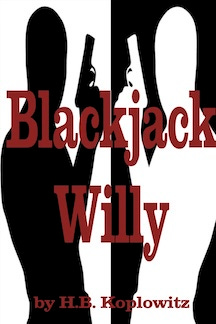
Barely in time for Christmas and Hanukkah, Blackjack Willy is now available at Amazon.com. Blackjack Willy takes readers on a journey into the dark heart of toxic masculinity. It’s also a multicultural murder mystery set in the 1980s. The quasi-noir whodunit is chock-full of mystery motifs, from a locked room to surprising twists and turns, leading to a shocking conclusion. Blackjack’s friend and girlfriend are found dead and he can’t remember where he was when they died. Did he kill them or was it the Monkey Demon? Is he the Monkey Demon? And what the heck is a Monkey Demon? Warning: Blackjack Willy is an unwoke work of fiction with explicit sex and other “adult” content, including bad ethnic humor and off-color language that should not be read by anyone. What follows is the book’s prolog (sic), which lets potential readers know what they’re in for.
Prolog: The Present
A watcher in the shadows peers into a moonlit room, where a beastly man bends a beautiful woman across a mahogany desk. His pants are at his ankles, her skirt is hiked above her hips. His ebony cock and her alabaster thighs shimmer in the moonlight, causing the voyeur to tremble, both revolted and aroused. The beast mounts the beauty from behind and she surrenders unconditionally, splaying her arms across the desk as if being crucified. In a primal call and response, she echoes his grunting thrusts with escalating squalls. The voyeur can’t stop a tiny, anguished moan from escaping as a humiliating orgasm builds irresistibly. Spasming in shame as well as pleasure, the watcher vows vengeance. A furtive fantasy has become a ghastly reckoning…
Do you really need a purple prologue? Especially since you don’t know how to spell prologue?
Well, I’ve read a few mystery novels, and I noticed they all seem to have prologs. I mean prologues. Besides, sex sells. So I thought I’d give it a try, especially since the goal of this exercise, when I started it a half-century ago, was to cram as many mystery novel clichés as I could into a single story.
No it wasn’t.
That’s true. The clichés came later. Chapter 1 began in 1974 as my first essay for an English 101 class at Southern Illinois University in my hometown of Carbondale. The teacher asked us to write a descriptive paragraph without people. Another section started out as my second English 101 assignment, which was to write in dialect, and I decided to try my hand at black lingo.
Smooth move, Ex-Lax.
As a mental exercise, I thought about turning the people and places I’d conjured for the class assignments into a whodunit with interracial and psychosexual undercurrents. Rather than worry about an outline, I’d let my imagination guide the evolution of the characters and plot. The impetus for the story was a barbecue restaurant/lounge on the east side of Carbondale where I worked for a minute in the early 1970s. The owner was a black ex-cop/ex-bank robber, and I was a lonely, long-haired busboy who would watch from the sidelines as smooth-talking spades hooked up with platinum blonde white chicks for interracial flings. So that was the core — three days in the life of a beguiling black lounge owner named Blackjack Willy and a scruffy, white, covetous, busboy named Hal.
A dubious foundation.
It remained a mental exercise until the mid 1980s, when in a burst of creativity I wrote the chapters that comprise Day 1 on a Kaypro computer in Decatur, Illinois. By day I was a bored state worker who by night snorted cocaine and tried to write a novel.
But the coke ran out and so did your creativity. Then you had a midlife crisis and decided to rekindle your writing dreams by heading to the city of second chances, La La Land.
In the 1990s I became a columnist for a weekly and copyedited for a regional news agency in Los Angeles. I also taught journalism at a college in South-Central L.A., where one of my students happened to be nicknamed “Blackjack.” Using an iMac computer that looked like a lamp, I rewrote what I had written and pushed the plot forward, halfway through Day 3, in fact. I added characters and began exploring back stories, plot twists, and playful tributaries, wherever my mind would wander. And I wasn’t doing cocaine then, just pot.
Someone has to say it. Your playful tributaries took you to some dark places.
All I can say is I didn’t plan to go there. The characters led me there, although that may be a distinction without a difference.
No shit Sherlock. Unable to write the ending, and also unable to inject the story with a speck of a theme, much less insights into interracial psychosexuality or anything else, you put the manuscript away again.
Then my parents died, and in 2011 I left my journalism career in Los Angeles and retired to their condo in Boca Raton, Florida, where I decided to give Blackjack Willy one more shot. I began to re-rewrite what I had rewritten and realized I had unintentionally created a fairly diverse cast of characters. I then intentionally tried to make it more diverse by adding a strong Latina character.
However, times had changed, and regardless of the diversity of the characters, exaggerating stereotypes had become not only politically incorrect and offensive, but worst of all, profoundly unfunny, especially coming from a straight, white, Jewish guy.
Indeed. And that’s what got me thinking about adding a “prolog” to trigger warn those who might find some of my stock characters, dialect, homophobia and nonconsensual sex to be objectionable.
And who might those people be?
Oh, blacks, gays, women and the disabled, for starters.
I see. So what did you come up with?
Well, you’ve heard of woke fiction. I wanted to alert readers that this is unwoke fiction. If it were a movie it would be R-rated for explicit sex and other “adult content,” including bad ethnic humor and off-color language, up to and including the n-word.
More like incel fiction, if you ask me.
I prefer to think of it as Freudian. The story is set in the 1980s, when males and females could still be chicks and dudes. A time before smartphones, social media and cancel culture, when a certain amount of ethnic and sexual banter was as much a bonding mechanism as it was actionable. In addition to all the other potentially objectionable material, there are numerous allusions, both personal and cultural, sprinkled throughout. One is the Monkey Demon, an homage to folksinger Richard Fariña, who used the term in his first and only 1966 novel Been Down So Long It Looks Like Up to Me. One reason I used “monkey” is because it has a “K” in it, like “Buick,” making it inherently funny. Unfortunately, the word has also become inherently racist.
Then you got stuck again and yet another decade passed.
That it did. But at 10 p.m. Thursday, July 15, 2021, nearly a half- century after I began this sordid tale about a dude named Blackjack Willy, I completed the rough draft. It was an auspicious occasion, as I was self-isolating with a case of Covid-19. Perhaps being 70 years old with a potentially fatal disease focused my mind on the fact that the marathon race to finish this story was coming to an end, one way or the other. Miraculously, the last 10,000 words poured out of me in a veritable torrent over the course of a sickly week. Despite the passage of so much time, the climax is very much as I envisioned it when I got the original idea 47 years before.
That’s nice. But getting back to the prologue, you really can’t use it.
Why not?
Because if you have to explain the joke, the joke’s not funny.
Well, the pendulum has swung again, so who knows. In a post-woke world, maybe it doesn’t matter anymore.
-30-
brilliant jounalism. Vulgar but what isn't these days. Truth to power, etc, etc
You never give up on old Blackjack.